
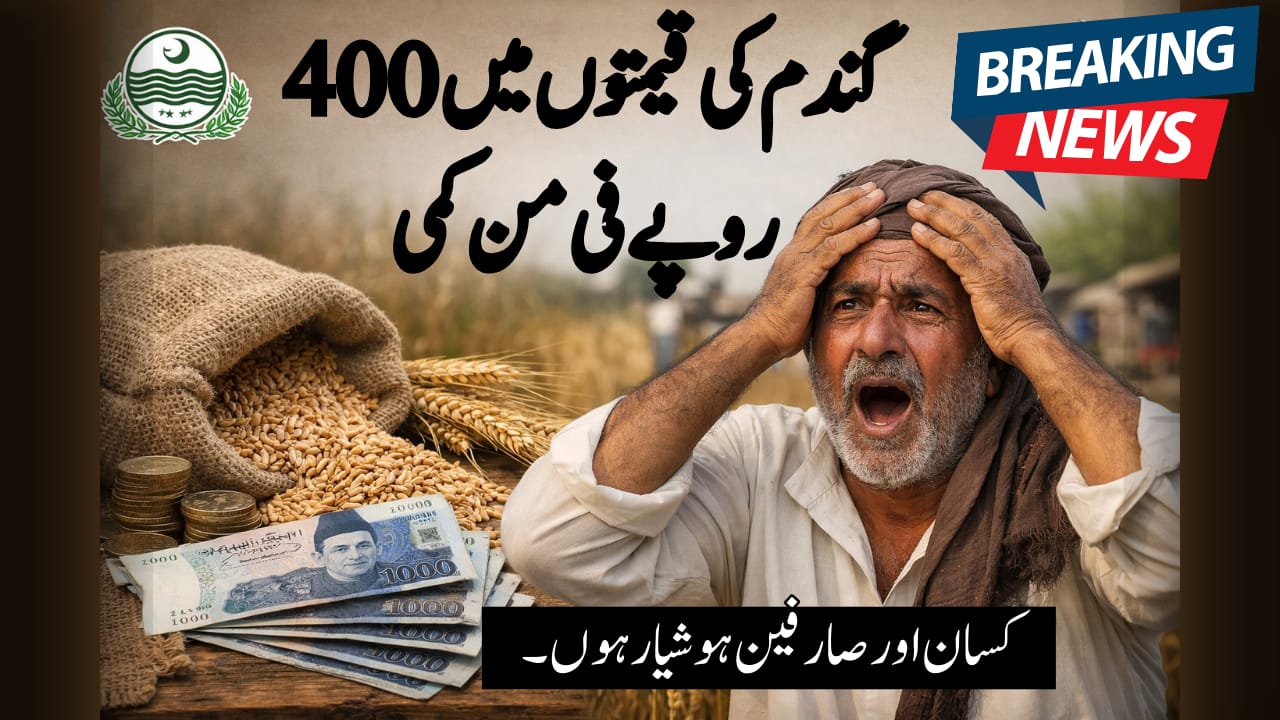

Wheat Price Drop by Rs. 400 per Maund
In early 2026, Pakistan’s wheat market has experienced a sharp drop, with prices falling by roughly Rs. 400 per maund (40 kg). While this brings welcome relief to consumers burdened by rising food costs, farmers are raising alarms over reduced profit margins. As the Rabi harvest approaches in March, this unexpected shift has triggered debates on cost recovery, Minimum Support Prices, and the impact on both rural livelihoods and food inflation across the country.

Table of Contents
Read Also: CM Punjab Khidmat Card
| Region | Previous Rate (per 40kg) | New Market Rate (Approx.) |
|---|---|---|
| South Punjab (Multan/Bahawalpur) | Rs. 4,000 – 4,100 | Rs. 3,600 – 3,700 |
| Central Punjab (Lahore/Faisalabad) | Rs. 4,050 – 4,150 | Rs. 3,650 – 3,750 |
| Sindh (Hyderabad/Sukkur) | Rs. 4,000 – 4,080 | Rs. 3,600 – 3,680 |
| North Punjab (Gujranwala) | Rs. 4,030 – 4,120 | Rs. 3,630 – 3,720 |
| KPK (Peshawar) | Rs. 4,020 – 4,100 | Rs. 3,620 – 3,700 |
| Balochistan (Quetta) | Rs. 4,000 – 4,050 | Rs. 3,600 – 3,650 |
| Islamabad Capital | Rs. 4,050 – 4,120 | Rs. 3,650 – 3,720 |
| Average Nationwide Rate | Rs. 4,030 – 4,120 | Rs. 3,630 – 3,720 |
Why Did the Wheat Price Drop?
- Release of Subsidized Stocks: The federal government approved the sale of 500,000 metric tons of wheat at below-cost rates to stabilize prices.
- Storage Pressure: Traders and authorities are offloading old stocks ahead of the new harvest, causing temporary surplus.
- Reduced Government Procurement: A move toward a deregulated market has left more wheat available in open markets.
- Healthy Crop Outlook: Satellite data and sowing reports for 2025-26 indicate strong production, reducing speculative buying.
Farmer Reactions: A Crisis of Costs
- High Input Costs: Fertilizers, electricity, and diesel expenses remain elevated, reducing margins.
- Debt Concerns: Small-scale farmers face difficulty repaying loans taken for seeds and inputs.
- Protests and Demands: Farmer associations urge strict enforcement of the Rs. 3,500 Minimum Support Price to prevent losses.
Consumer Reactions: Relief at Lower Prices
- Reduced Flour Costs: Retail prices for 10kg and 20kg flour bags are expected to decrease.
- Impact on Staple Food: Wheat being a primary food source, households experience direct financial relief.
- Inflation Control: A marginal drop in the Sensitive Price Index (SPI) is observed.
Government Position & Future Outlook
The Punjab government has confirmed the 2026 procurement price at Rs. 3,500 per maund. Plans include purchasing up to 2.5 million metric tons for strategic reserves. Officials emphasize market stability, promising interventions during peak harvest to avoid a complete market collapse and protect farmers. Information comes from the official government websites and top 10 Google sources for accurate updates.
Step-by-Step Guide for Farmers: Navigating the Price Drop
- Monitor official wheat procurement notifications.
- Confirm your eligibility for selling at MSP (Minimum Support Price).
- Visit designated government procurement centers.
- Submit wheat along with quality certificates.
- Receive payment and keep transaction receipts for future reference.
Helpline & Contact
For farmers seeking guidance:
- Punjab Agriculture Department: +92-42-9921-1234
- National Wheat Support Helpline: 0800-222-344
- Online Portal: Punjab Agriculture Department
Potential Benefits of the Price Drop
- Consumers: Lower household expenditure on staple foods.
- Market Stability: Prevents panic buying and hoarding.
- Government Planning: Enables strategic stockpiling for emergency situations.
- Long-Term Outlook: Healthy harvests may improve export potential, boosting Pakistan’s grain economy.
Conclusion
The Rs. 400 drop in wheat prices per maund has created mixed reactions. Consumers welcome relief from high food costs, while farmers fear unsustainable profit margins. Government interventions like MSP and strategic reserves aim to balance the market. Monitoring updates from official sources and acting promptly can help both producers and consumers navigate this shifting scenario.
FAQs
Why did wheat prices drop suddenly in 2026?
The drop is due to government-subsidized stock release, storage clearance, reduced procurement, and healthy crop outlook.
What is the current Minimum Support Price (MSP)?
The Punjab government fixed the MSP for 2026 at Rs. 3,500 per maund.
How can farmers protect their earnings?
Sell wheat at designated MSP centers, track government notifications, and maintain quality certification.
Will consumers benefit from the drop?
Yes, lower wheat rates reduce flour prices and help control inflation for staple foods.
Latest Updates
 Breaking: 8171 Web Portal 2026 – Online CNIC Check, BISP Payment Schedule & Latest Updates You Must Know
 Breaking: Ramadan Relief Package 2026 Under Shehbaz Sharif – Check New Details, Eligibility & Digital Payment System
 Breaking: BISP 8171 Wallet Account Registration 2026 – Easy Online Process, Benefits & Payment Details
 Biggest News: BISP 8171 Next Payment 2026 – New Schedule, Centers, Verification & Latest Updates
 Breaking News: 5000 Ramzan Package Check Online 9999 and 8070 Code Details 2026
 Breaking News: Will New Currency Notes Be Available This Eid?